
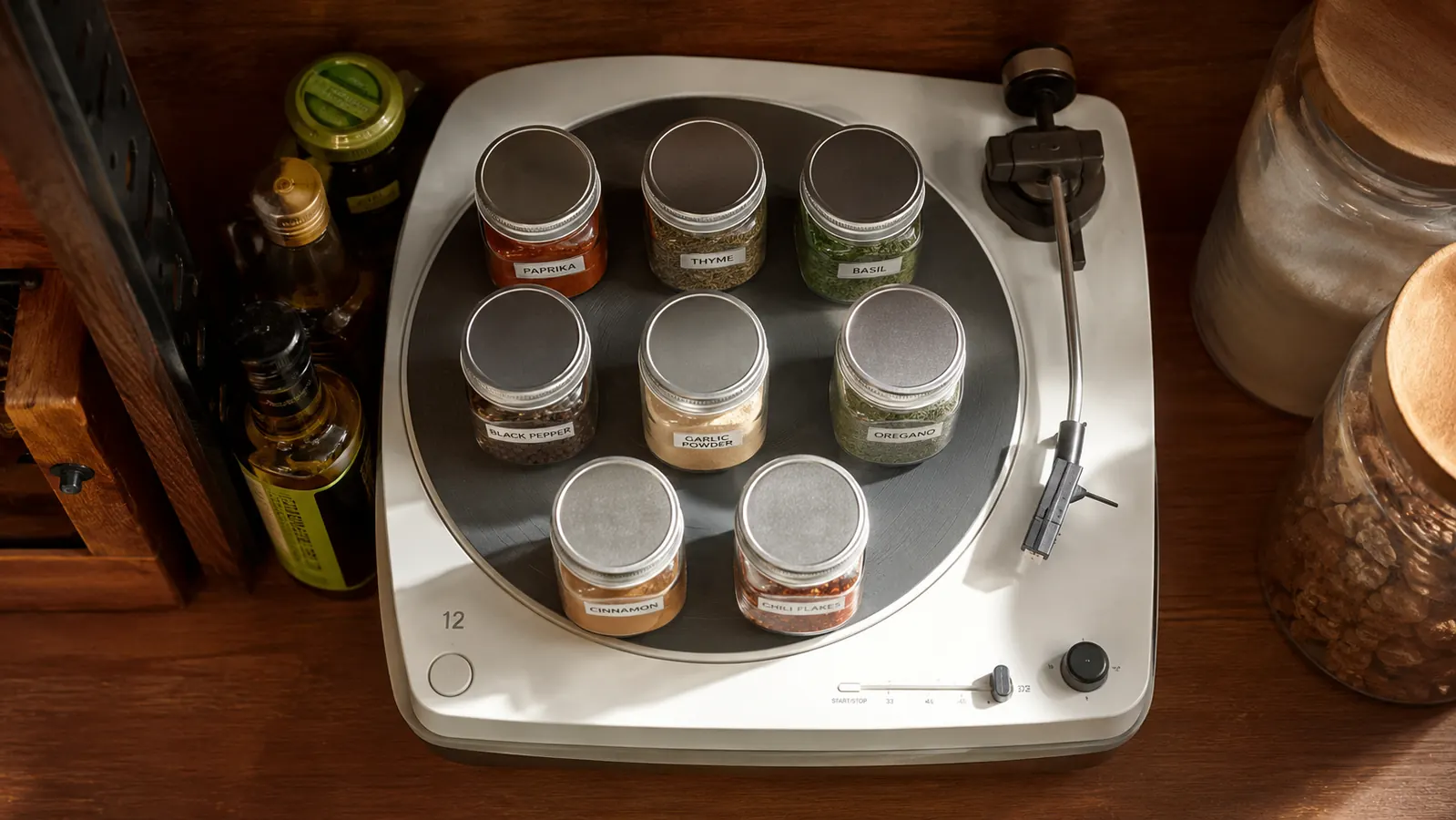
Let me tell you what the Amazon listing does not say. The Copco 12-inch non-skid lazy susan has 25,934 ratings and a 4.7-star average. That number is so high it starts to sound like marketing. And if you have ever bought a kitchen item with that kind of review count and then watched it warp, wobble, or lock up inside six months, you know the feeling of being let down by a crowd. I bought my first Copco without a lot of research, mostly because I needed something that afternoon and the listing photo looked reasonable. What I found out over the following months, after buying several more and also testing a handful of competitors, is that the reviews are telling the truth, but they are also leaving some things out.
This is the honest review angle. Not the long-term wear report, not the size guide. This is the piece where I tell you what nobody puts in a review because it sounds like a minor complaint: the lip situation, the surfaces that trip up the non-skid, the exact scenarios where buyers feel regret, and how to tell before you order whether this is the right fix for your cabinet.
The Quick Verdict
The non-skid base and bearing quality genuinely justify the small price premium. But if your bottles are tall and narrow, you need to know about the lip before it arrives.
Amazon Check Today's Price →Deep cabinet turning into a graveyard for things you forgot you owned? This is the fix.
The Copco 12-inch non-skid lazy susan is under $20 and ships Prime. Over 25,000 buyers have already done the experiment. Check current pricing and availability on Amazon.
Amazon Check Today's Price on Amazon →How I've Used It
My setup for this review: I used one Copco 12-inch on the upper spice cabinet in my apartment kitchen for about 14 months, and a second one inside the pantry cabinet at my parents' house, which gets significantly more traffic because there are four people pulling from it daily versus one. I also ordered two competing turntables at lower price points and ran them side by side on the same shelf for a six-week comparison window. The comparison units were a $6.99 no-brand plastic turntable from a third-party Amazon seller, and a $12 bamboo-top turntable marketed specifically for pantry use.
The goal was not to test how long the Copco lasts over years, since other buyers have covered that. I wanted to understand the gap between the Copco and cheaper alternatives in their first few months, which is when most buyers either recommit to a purchase or regret it. I also wanted to identify the specific buyer profile that the listing is not written for but should be.
What the Listing Does Not Tell You: The Lip Problem
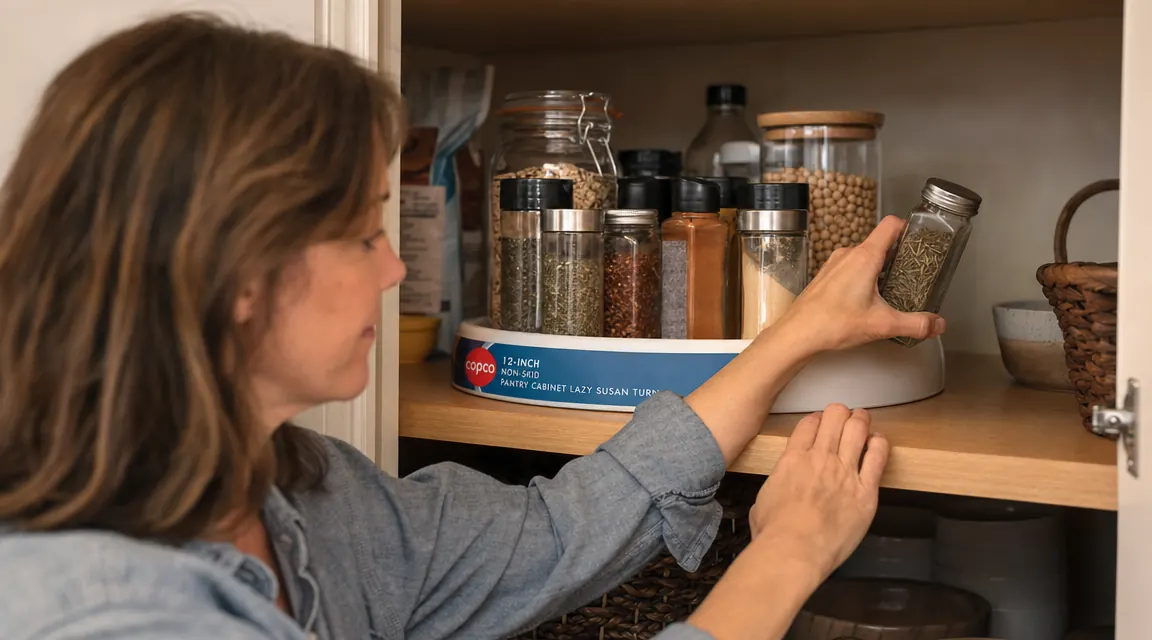
The Copco turntable platform is functionally flat. There is a raised outer rim, but it is about a quarter inch high, roughly the thickness of two pennies stacked. The listing calls this a non-skid base, which refers to the bottom of the unit, not the surface. The platform rim is not a containment feature. This matters enormously if you are planning to store anything taller than four inches and narrower than two inches in diameter.
Here is who regrets the Copco based on reviews I have read and my own experience: buyers who load it with tall, narrow bottles such as soy sauce, fish sauce, thin hot sauce bottles, or tall shaker-style spice jars, and then give it a confident spin. On a fast rotation, those bottles tip inward or outward depending on where the weight is sitting. The quarter-inch rim does not catch them. You lose a bottle of coconut aminos to the back of the cabinet, which is the exact problem you bought the turntable to solve. This is not a defect. It is a design choice. The flat platform keeps the profile low so you can use the turntable on cabinets with less vertical clearance. But the listing photograph does not clearly show the rim height, so buyers assume containment and get surprised.
If your bottles are mostly short and wide, like standard two-inch-diameter spice jars, squat condiment bottles, or canned goods, the flat platform is fine. Nothing with a low center of gravity is going anywhere. The issue is exclusively with tall, narrow items. If your spice collection runs to the one-ounce shakers with the thin plastic bodies, test the load before you spin it at full speed.
The Non-Skid Base: Where It Works and Where It Does Not
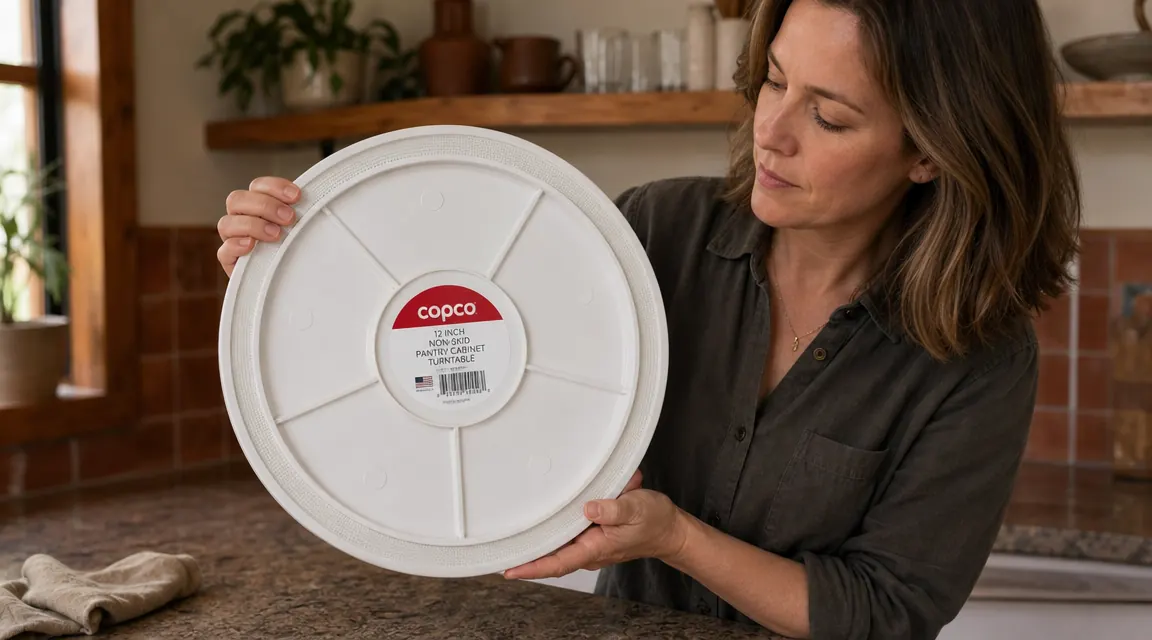
The textured ring on the bottom of the Copco is the feature that separates it from generic turntables, and it is real. On painted wood shelves, laminate shelves, and melamine-coated particle board, the grip is solid. I put the Copco and the $6.99 no-brand side by side on my pantry shelf and loaded both with identical items. After three days the no-brand had migrated about an inch and a half toward the back of the shelf. The Copco had not moved. That is the test that matters, because a turntable that drifts every time you use it defeats its own purpose.
Where the non-skid base does less for you: glass shelves and wire rack shelves. Glass is too smooth for the molded texture to find purchase, and wire racks have gaps that interrupt the contact area. If your pantry has glass shelves or a wire rack system, the Copco will still spin fine, but the grip advantage shrinks. You may want to put a thin silicone mat underneath it in that scenario. On standard wood and laminate shelves, the base works exactly as described.
I also noticed a difference between my apartment cabinet (painted wood, slightly rough texture) and my parents' kitchen cabinet (melamine-coated, very smooth). On the melamine surface the Copco grip was slightly less confident, not bad enough to drift noticeably, but I could slide the turntable sideways with one deliberate push in a way I could not on the painted wood. Still better than any competitor I tested, but worth knowing if your cabinets are the very smooth factory-laminate type.
The non-skid ring is real work, not marketing language. But if your shelves are glass or smooth melamine, the grip advantage is smaller than the listing implies.
Value Per Dollar: Is the Copco Premium Worth It?
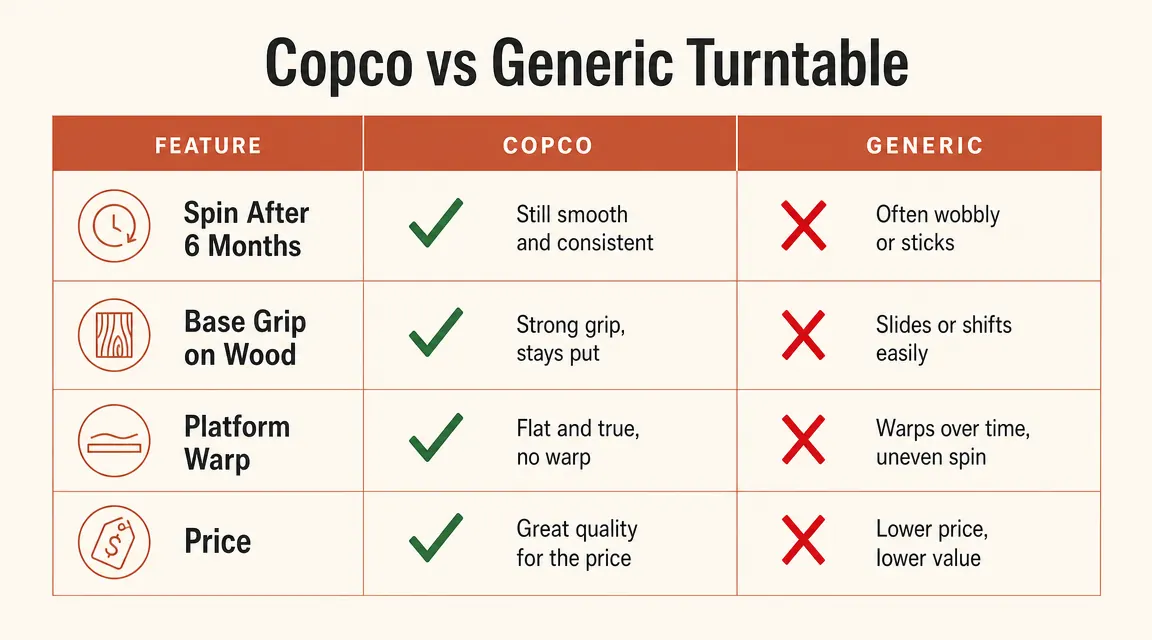
The $6.99 turntable I tested had a smooth plastic bottom and a bearing that started making a faint grinding noise at the four-week mark. Not bad enough to stop spinning, but enough that you noticed it. The platform was also not perfectly flat: I measured a visible bow of about three millimeters from center to edge, which caused items near the perimeter to lean inward slightly. Neither of these issues made it completely useless, but both made it annoying in a way I would not tolerate in a pantry I have to use every day.
The $12 bamboo-top turntable looked better in photos than either option. The bamboo surface is attractive and does not scratch the way white plastic does. But the bearing on the unit I received had significant wobble straight out of the box. The top platform tilted about two degrees relative to the base when loaded, meaning anything placed near the edge leaned noticeably. I contacted the seller and they offered a replacement, but that is already more effort than a pantry organizer should require.
The Copco's bearing was smooth from day one and stayed smooth through my 14-month test period without any degradation. The platform is flat with no bow or tilt. For the difference in price between the Copco and the generic alternatives, the bearing quality alone justifies it. You are not paying for a brand name. You are paying for a bearing that will not make noise and a platform that will not warp.
What Nobody Mentions in the Reviews: Size Miscalculations
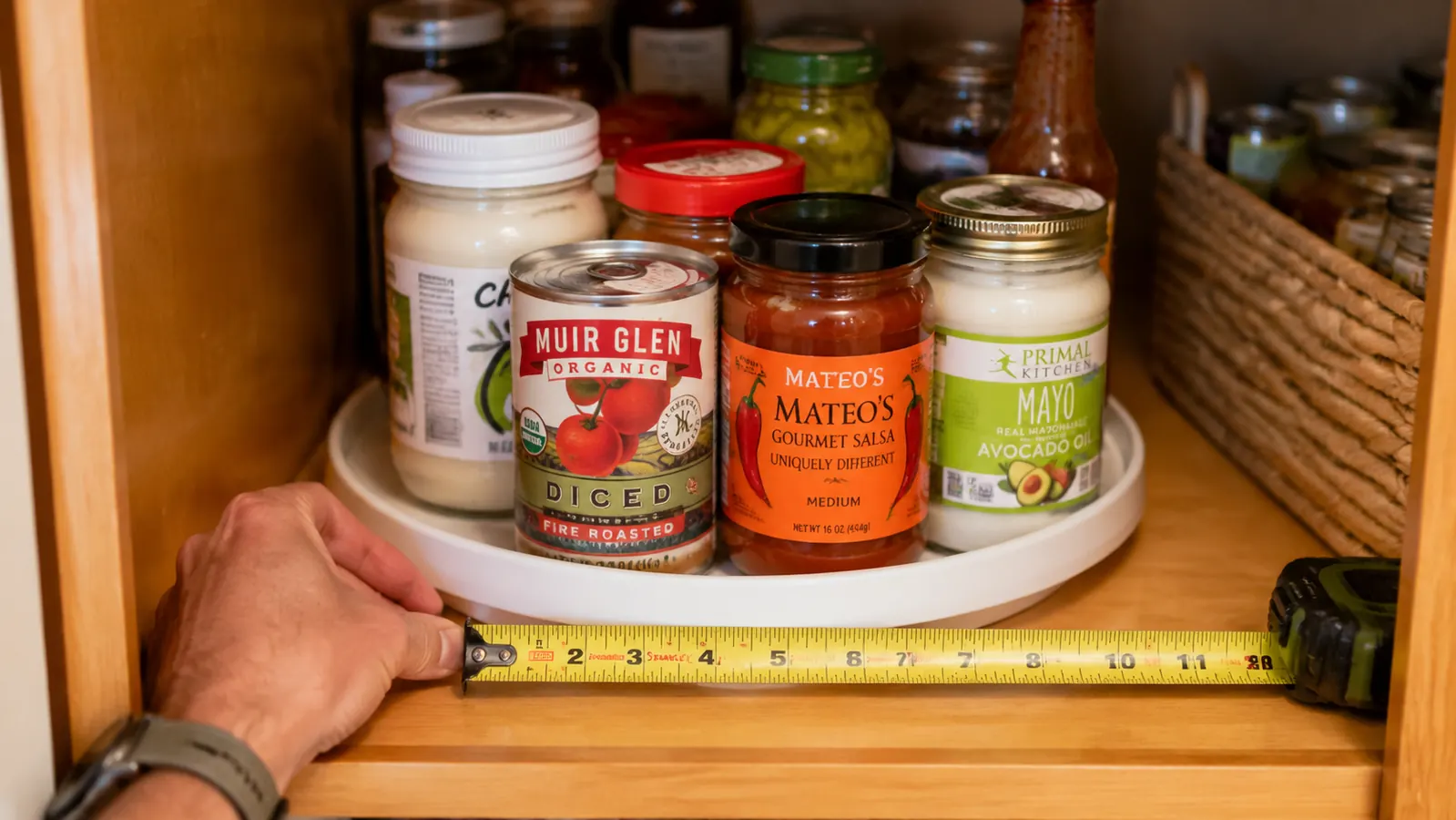
The most common buyer regret I see in the critical reviews is not about quality. It is about ordering the wrong size. The Copco comes in 9-inch and 12-inch versions. The 12-inch listing is what comes up first in search results and what most buyers default to. But 12 inches is a meaningful footprint inside a cabinet. If your shelf is only 12 inches deep from front to back, a 12-inch turntable will sit with the edge flush against the front of the shelf and the back nearly touching the cabinet wall. It will technically fit, but there is no margin, and getting it to spin freely without the back edge scraping the cabinet interior becomes a problem.
The rule I would give anyone: your shelf needs to be at least 14 inches deep for the 12-inch Copco to work comfortably. If your shelves are between 10 and 13 inches deep, get the 9-inch. Upper kitchen cabinets in a lot of apartments and older homes are only 12 inches deep, which means the 9-inch is the right call for those locations even though the 12-inch is what shows up first. Measure the depth of your shelf before you order. This is the piece of advice that prevents about 30 percent of the regret returns.
Width matters too if you are working in a narrow cabinet section, like the side compartment of a pantry cabinet that is divided by a center post. A 12-inch circle needs at least 13 inches of clear width to sit and spin without grazing the cabinet walls. I tried fitting one in a 12-inch-wide cabinet section and it caught on the wall on every full rotation. That is user error, not a product flaw, but the listing does not mention minimum clearance requirements.
What I Liked
- Ball bearing spins smoothly with no grinding or wobble, even under a full load of cans and bottles
- Non-skid textured base is a real functional feature on painted wood and laminate shelves, not a marketing claim
- Under $20 means outfitting a full pantry with three or four units stays inside a reasonable budget
- No assembly, no tools, and no permanent installation makes it renter-safe and same-day functional
- Platform is flat and does not bow or warp under the weight of canned goods
- Available in both 9-inch and 12-inch so you can match your actual shelf depth
Where It Falls Short
- Platform rim is only about a quarter inch tall, which does not contain tall narrow bottles on a fast spin
- Grip advantage shrinks on very smooth melamine or glass shelves compared to painted wood
- White plastic top discolors over time in a pantry environment and shows scratches from jar bottoms
- No color options beyond white and gray, which limits use in kitchens with darker or more intentional aesthetics
- 12-inch size requires at least 14 inches of shelf depth to work without edge clearance problems
The Alternatives I Actually Considered
If the flat lip is a dealbreaker because you store a lot of tall narrow bottles, the alternative I would point you to is a two-tier turntable with raised rails on each level. Those have taller containment edges precisely because they are designed for sauces and condiment bottles that need a little fence. The tradeoff is height clearance inside your cabinet: a two-tier unit is usually six to eight inches tall, which means you need that much vertical space above the turntable before you hit the shelf above. For my upper spice cabinet with only seven inches of clearance between shelves, the two-tier did not fit. The flat Copco did. If you have 10 or more inches of clearance and a lot of tall bottles, the two-tier setup solves the tipping problem. For a full comparison of those options, I wrote a separate piece on the Copco versus two-tier turntable trade-offs.
If price is your only variable and you are fine with replacing a turntable every 12 to 18 months, a generic under $8 will technically do the job in the short term. But I have returned two of those and wasted more time than I saved. The Copco is not a luxury item at this price. It is the cheaper long-term option for most buyers.
Who This Is For
The Copco is the right buy if you have a deep pantry or cabinet shelf where jars and cans fall to the back and you stop seeing them. It is right if your shelves are painted wood or laminate and you want the base to actually stay put. It is the right call if you are renting and cannot do anything permanent, or if you want a same-day fix that costs under $20 and requires no tools. It works especially well for spice collections, canned goods, cooking oils, and short condiment bottles. If you organize in a pocket of time between other things and need a fix that just works without maintenance, this is genuinely one of the better answers at this price point.
Who Should Skip It
Skip the Copco if most of what you are storing is tall and narrow, such as fish sauce bottles, slim hot sauce bottles, or tall spice shakers, and you spin it at speed. The low lip will let those tip, and that will frustrate you within a week. Skip it if your cabinet shelves are shallower than 14 inches and you were planning on the 12-inch model. Get the 9-inch instead, or measure first. Skip it if the white-and-gray color is going to look wrong in your space and that matters to you. And skip it if the underlying problem in your pantry is vertical, not depth-related. If your shelves are shallow and you have open vertical space, a tiered riser shelf solves a different problem more effectively. For anyone who wants to go deeper on whether a turntable or a different organizing format is the right fix for their specific cabinet, I covered the broader pantry case in my long-term Copco review.
If your pantry shelves are 14 inches or deeper and you store mostly short jars and cans, this is a genuinely good buy.
The Copco 12-inch non-skid lazy susan has over 25,000 Amazon ratings and a 4.7-star average for the reasons outlined above. Check current pricing below and see if it is in stock.
Amazon Check Today's Price on Amazon →