
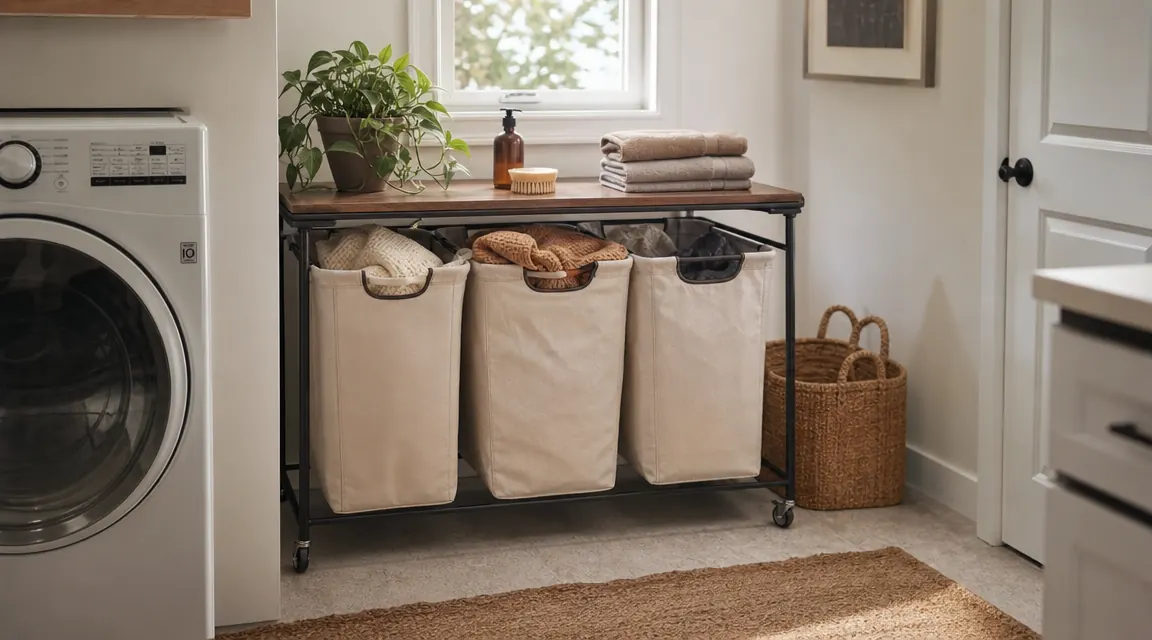
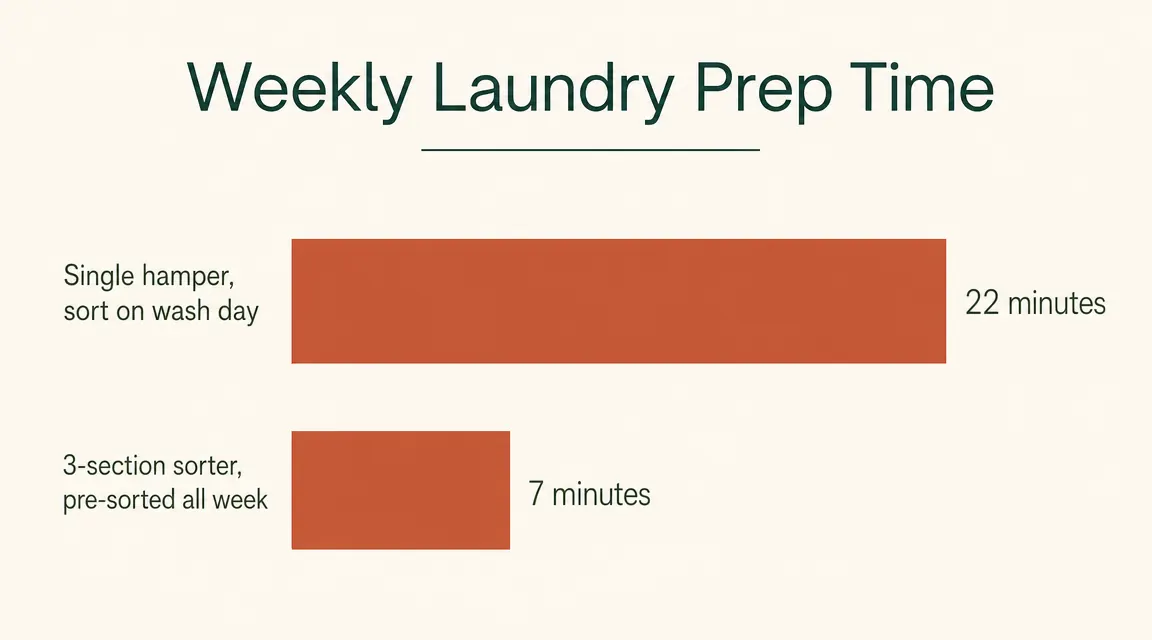
For years I used whatever hamper happened to be on clearance. Last year that meant a single canvas basket, 22 inches tall, parked in the corner of our bedroom. Every Sunday I dumped the whole thing onto the floor, sorted darks, lights, and towels into three separate piles on the bathroom tile, then started five loads back to back. The sorting alone took twenty minutes. My husband thought I was being dramatic when I complained about it. I started timing myself with my phone to make the point.
I bought the STORAGE MANIAC 3-section rolling laundry sorter in the spring of last year. My family of four runs about five loads a week, sometimes six in summer when the kids are in sports and every jersey and practice sock needs to be clean by Monday. This is a year-in review, not a first-week impression. I know what holds up, what started to wear, and what I wish I had checked before ordering.
The Quick Verdict
Genuinely saves time on wash day if you commit to pre-sorting as you go. The frame is solid for the price. Two real flaws: the zipper pulls on the bags are flimsy, and the cart is wide enough that it will not roll through some interior doorways without tilting it sideways.
Amazon Check Today's Price →Done losing Sunday mornings to sorting a pile on the bathroom floor? This cart pre-sorts for you all week.
The STORAGE MANIAC 3-section sorter has a 4.6-star rating from over 22,000 buyers on Amazon. Check today's price before you buy another single hamper you will outgrow in a month.
Amazon Check Today's Price on Amazon →How I Have Used It for the Past Year
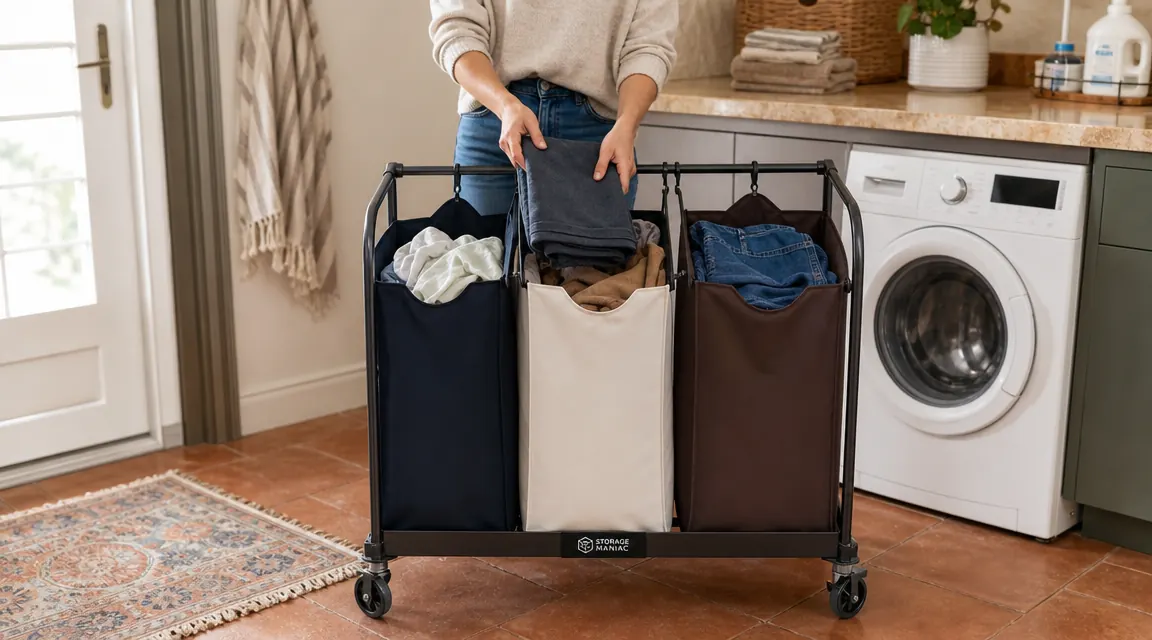
The cart lives in our upstairs hallway, parked between the kids' rooms and the primary bedroom. That placement is deliberate. It is the first thing anyone passes when they come out of a room in pajamas or sports clothes. The three fabric bags are labeled with two-inch iron-on letters I cut from a craft store sheet: D for darks, L for lights, T for towels and linens. My son is eleven and my daughter is eight. Both of them now drop clothes directly into the correct bag without being reminded. That behavioral shift alone was worth the purchase price to me.
On wash day, I lift each bag off its frame hook, carry it to the laundry room, and dump it straight into the machine. No sorting pile. No picking through a tangled mound to separate a white undershirt from a dark sock. I timed myself on a typical Sunday: seven minutes from first bag to first machine running. That compares to twenty-two minutes before, which included the sort, the trips back and forth, and the second pass through the pile to catch what I missed. The savings compound over a year. That is roughly eleven hours of laundry prep time I got back.
I have rolled this cart over hardwood, ceramic tile, and a low-pile hallway runner. The wheels handle all three without drama. The only surface where I get any resistance is a thick bathroom runner near the master bath. The front casters catch the pile and you have to lift and redirect. Not a dealbreaker, but a thick rug across a doorway or hallway path will slow the cart down.
What the Frame and Bags Look Like Up Close
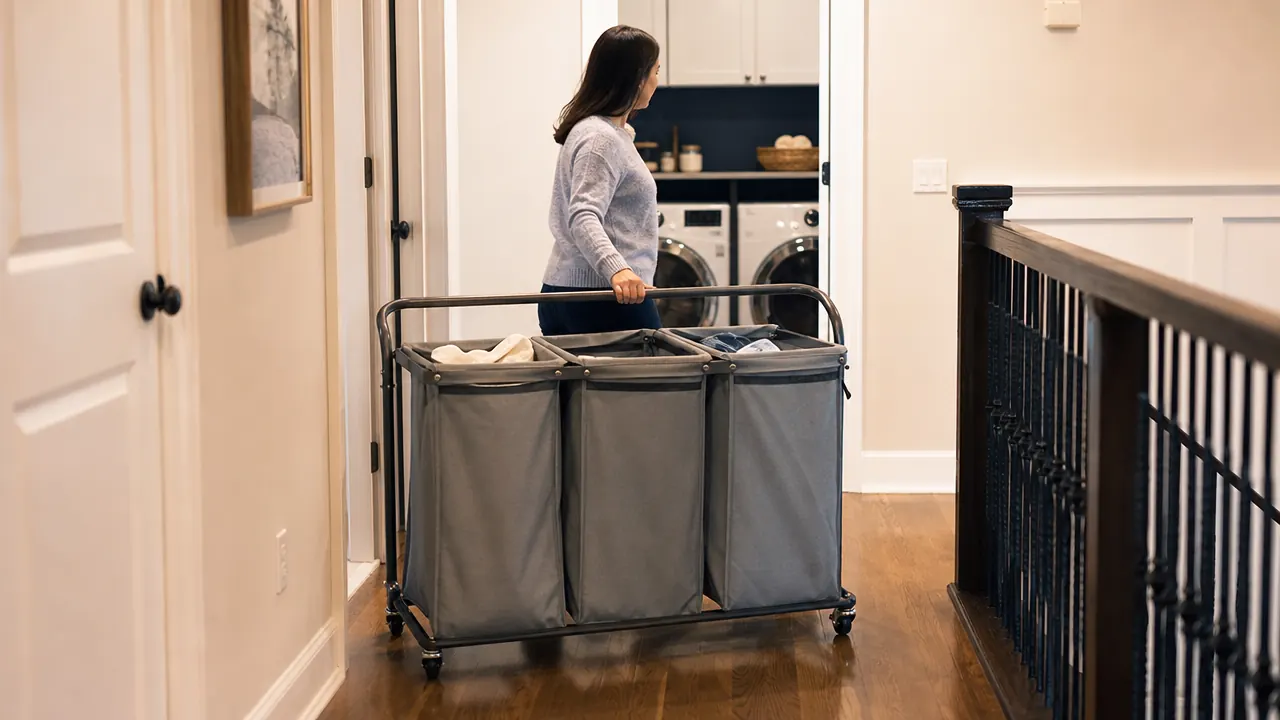
The frame is powder-coated steel tube. Dimensions are 23.6 inches wide, 13.4 inches deep, and 34.6 inches tall. I measured my hallway closet door and our laundry room door before ordering because width was my main concern. It clears our 26-inch laundry room door with about an inch and a quarter on each side, which is enough to roll through without scraping. If your interior doorways are narrower than 25 inches, this cart will not go through without tilting. Older homes and many apartments run 24-inch interior doors. Check that measurement first.
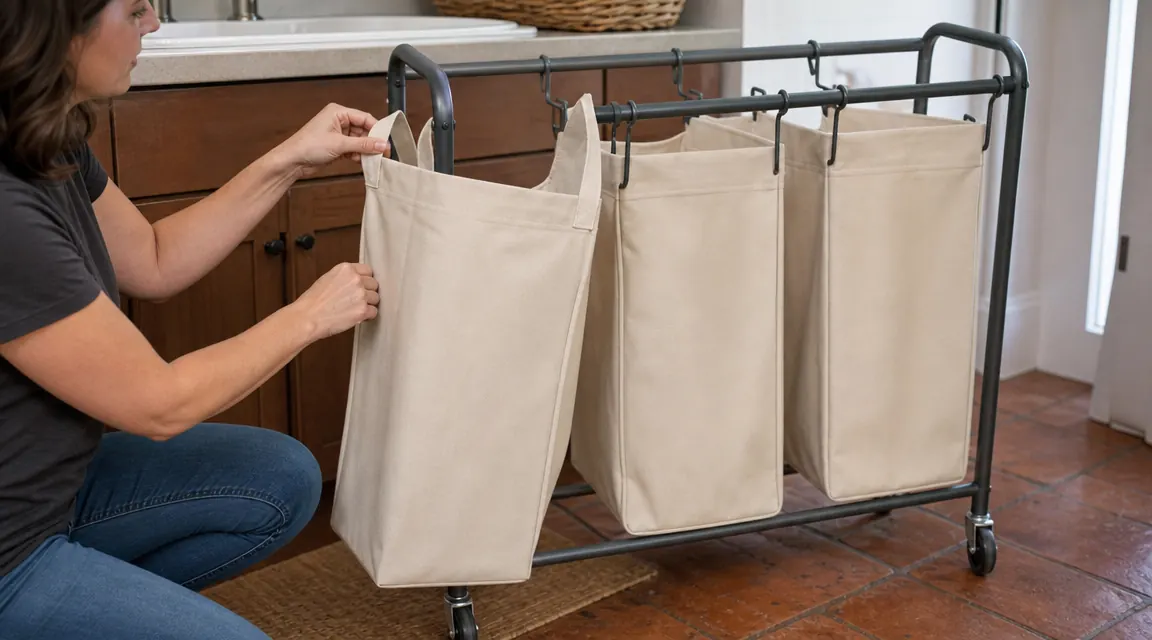
The three fabric bags each hold roughly 11.8 gallons, for a total sorter capacity of 35.6 gallons. That is enough for two adults and two kids doing laundry twice a week before the bags start to push out at the sides. If you are a family of five or running longer gaps between wash days, you will routinely overload them. A very full bag can pop its loop off the frame hook when you pull it off. That has happened to me twice in twelve months, both times when I let the towel bag fill past the rim.
The bags are a polyester-cotton blend with a mesh liner. After a year of weekly use and washing the bags themselves roughly once a month, they are structurally intact. The shape has loosened slightly as the fabric softened, which actually makes them easier to hook and unhook from the frame. The color has faded slightly on the dark bag from washing. That is cosmetic. The actual durability problem is the zipper pulls.
The One Part That Will Wear Out First
Each bag has two zipper pulls, one at each end of the top opening. After about nine months of regular use, three of the six pulls started to fray at the base where the fabric tab meets the metal slider. None have failed completely after twelve months, but I would not bet on all six surviving another year of daily use. This is the most likely failure point on the whole cart. It is also the most frustrating because the frame and wheels are fine, and a couple of frayed zipper pulls make the whole thing look ratty.
Replacement bags that fit this frame are sold separately on Amazon. A set of three runs under fifteen dollars, which is worth knowing before you assume the cart is done when the first bag fails. The frame itself should last considerably longer than the bags if you are not using it in a damp basement or leaving it outside.
The Wheels After Twelve Months of Rolling
Four swivel casters, each 1.5 inches in diameter, made from hard plastic rather than rubber. The two front wheels have a lock tab on the side of the caster housing. I use the locks when the bags are full because a loaded cart on hardwood will drift when you pull a bag off-center. After twelve months, three of the four lock tabs still engage cleanly. The fourth has a small crack in the tab that makes it stiff to push down. It still locks, but it requires deliberate pressure instead of a casual click. Replacement casters with the same bolt pattern are easy to find online for a few dollars, and the mounting bolts are standard size.
Rolling noise is low on tile and hardwood and essentially silent on carpet. On polished concrete, the hard plastic casters make a faint click-roll sound. In a typical home setting this is not noticeable. The cart does not rattle or creak when loaded and moving.
The sorting pile on the floor was a Sunday ritual I did not realize I could just eliminate. Once the kids knew which bin to drop clothes into, wash day stopped being an event I dreaded and became something I finished before lunch.
What Changed Over a Full Year of Use
The steel frame has not bent, rusted, or loosened at any joint in twelve months. I expected some wobble at the cross-bar connections given the price point, but the frame still feels as rigid as when I assembled it. Assembly took nineteen minutes working alone with a medium Phillips screwdriver. The included instruction sheet is clear, with labeled diagrams, and I did not need to look anything up online.
The powder coat on the frame has two small chips near the base where the cart contacts the wall in our hallway. Both are cosmetic, and there is no rust at either chip even after a humid summer. That is a reasonable result. The bag fabric, the zipper pulls, and eventually one caster lock tab are the wear points. The frame is not.
The behavioral change in my household surprised me. My husband, who previously left clothes on the floor next to the old hamper, now puts things in the correct bin because the bins are labeled and the sorting is already done for him. My daughter treats it like a game. My son occasionally misses the darks bag and throws a navy shirt into the lights, but his accuracy rate is probably 90 percent, which is better than mine when I was rushing.
What I Liked
- Pre-sorting eliminates the single biggest time drain on wash day, the floor-pile sort
- Steel frame stayed rigid and rust-free through a full year of use, no loose joints
- Easy bag removal on the hook system makes carrying a full load a clean one-trip job
- Kids old enough to read a label will sort themselves, no prompting needed
- Quiet on carpet and hardwood, no rattle or creak when loaded and rolling
- Replacement bags are sold separately, so bag wear does not mean replacing the whole cart
Where It Falls Short
- Width of 23.6 inches will not roll through standard 24-inch interior doors without tilting
- Zipper pulls on the bags started fraying at around nine months of regular use
- One of four caster lock tabs cracked and became stiff after twelve months
- Overstuffed bags can pop off frame hooks on removal, especially the towel section
- 35.6-gallon capacity is enough for four people but tight for five or longer gaps between wash days
Alternatives I Looked at Before Buying
Before ordering I compared three other carts. The Honey-Can-Do three-section hamper has a similar frame but uses open mesh bags. I ruled it out because small socks fall through mesh, and I have lost enough single socks in my life. The Simple Houseware version costs a few dollars less but uses lighter-gauge steel tubing that reviewers consistently describe as flexible under load, which means wobble when the bags are full. The Whitmor chrome three-section hamper is heavier duty but also taller and wider, which would block the path in our hallway.
The STORAGE MANIAC hit the right combination of frame stiffness, solid-fabric bags, total capacity, and compact enough footprint for a hallway. It is not the only workable option in this category, but it was the most practical fit for my setup at this price range.
Who This Is For
This cart makes the most sense if you do laundry for three or more people and you are currently sorting from a single hamper or off the floor on wash day. If you have a direct path from where people change clothes to the laundry room, and no doorway narrower than 25 inches along that route, you can roll it through without ever lifting it. Families with kids old enough to read a two-letter label will get the biggest payoff, because pre-sorting becomes a habit when the right bin is right there in the hallway.
Who Should Skip It
Skip this cart if you live alone or do laundry for just two people. The 35.6-gallon capacity is more than a two-person household needs between wash days, and a single well-made hamper will take up less floor space and serve you better. Also skip it if your interior doorways run at standard 24-inch width and the cart needs to move room to room regularly. Tilting a loaded cart through a narrow doorway every wash day is not a sustainable habit. And if you want something that looks like bedroom furniture rather than a laundry utility cart, this one reads as exactly what it is.
For more on whether a rolling sorter makes sense for your specific laundry setup, my piece on the laundry sorter cart vs single hamper breaks down the time cost comparison side by side. If you are still deciding whether a three-section system is worth it at all, the 10 reasons a rolling sorter beats floor piles makes the case quickly.
A year in, I would buy this cart again. The frame held. The system works. Just budget for replacement bag pulls.
The STORAGE MANIAC 3-section rolling laundry sorter is rated 4.6 stars by more than 22,000 people on Amazon. If the width fits your doorways and you are managing laundry for three or more people, this is the most practical cart at this price point. Check today's price and availability below.
Amazon Check Today's Price on Amazon →